
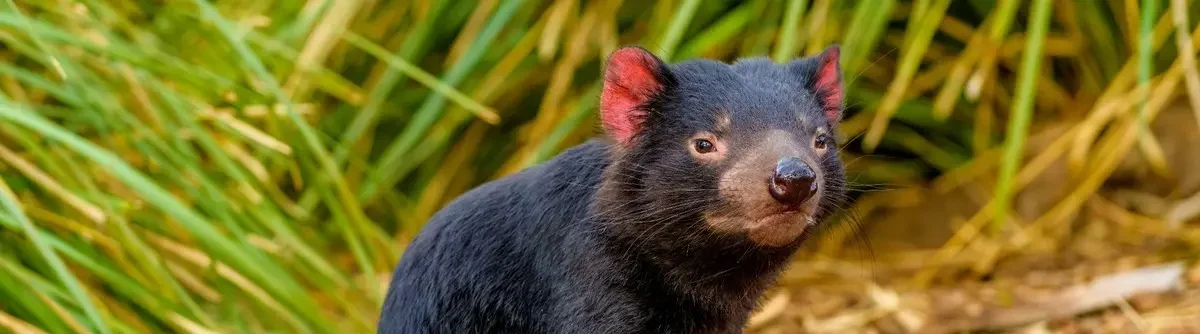

As the world’s largest living carnivorous marsupial, the Tasmanian devil (Sarcophilus harrisii), plays an essential role in maintaining healthy ecosystems. As both an apex scavenger and predator, devils help control invasive predators like feral cats while removing carrion from the landscape, supporting the health of countless native species. Today, that ecological role is under threat from two independent strains of transmissible cancers.
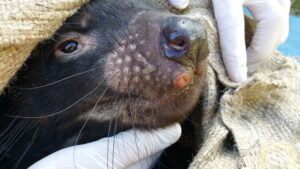
Photo Credit: Andy Flies at University of Tasmania
Devil facial tumour disease (DFTD) is one of the only known contagious cancers in mammals. Spread through biting during feeding and social interactions, it causes aggressive tumors around the face and mouth that eventually prevent affected animals from eating. Nearly every infected devil dies.
DFTD1 was first identified in 1996, the disease has spread across much of Tasmania. A second transmissible cancer, DFTD2, was discovered in 2014, reinforcing the need for new conservation solutions that can protect the species into the future.
The Colossal Foundation and the University of Tasmania are pursuing a two-pronged strategy designed to help the devil immune system recognize and fight DFTD.
The first is an advanced vaccine program. The Wild Immunology Group at the University of Tasmania has developed a field-ready oral bait vaccine designed to train the devil immune system to recognize and destroy DFT1 and DFT2 cells that could one day protect wild devils across the Tasmanian landscape without requiring every animal to be trapped and injected.
The second is a gene-editing strategy centered on LZTR1, a gene connected to cancer-relevant pathways in other species and hypothesized to play an important role in the origin and biology of devil facial tumors. Tasmanian devils carry two unusual amino-acid substitutions in LZTR1 that are not found in other mammals, and the “shattering” of one copy of the gene has been identified as a potential driver event in the origin of DFT1. Colossal and University of Tasmania will explore whether targeted editing of the devil-specific LZTR1 mutations, to match the ancestral mammalian sequence, could reduce devils’ underlying susceptibility to these transmissible cancers.
Together, these efforts offer new hope for Tasmanian devils and establish a new model for applying biotechnology to combat emerging wildlife diseases around the world.
“We’ve spent years developing a vaccine designed to train the devil immune system to fight these cancers, but progress is slow due to the challenges of working with an endangered species and having a lack of marsupial research tools,” said Associate Professor Andrew Flies. “Partnering with the Colossal Foundation can significantly accelerate our vaccine work, and allow us to explore a gene-editing strategy in parallel that could enhance the vaccine and make devils more resistant to DFTD.”
Meet the Fat-Tailed Dunnart
No bigger than a mouse, the fat-tailed dunnart (Sminthopsis crassicaudata) has become an important model for marsupial research. As a dasyurid, it shares deep evolutionary roots with both the Tasmanian devil and the thylacine.
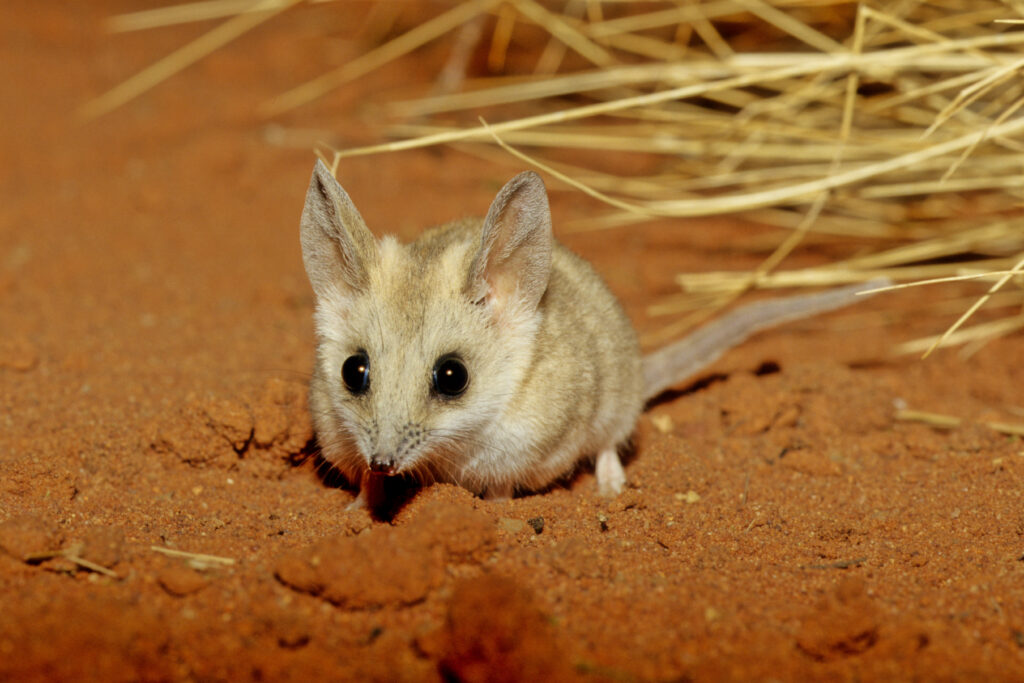
Through the thylacine de-extinction program, Colossal developed a powerful set of tools for marsupial research from the dunnart: a complete genome, cell lines, induced pluripotent stem cells, genome editing, and assisted reproductive technologies. These tools are the foundation for testing DFTD vaccines and gene-editing strategies safely, before they ever reach a living devil.
The Science Behind the Effort
Establishing the Dunnart Research Colony
The Colossal Foundation is supporting the University in establishing a dunnart colony in Hobart. Colossal Australia’s animal-care team will host University of Tasmania veterinarians and animal services staff to transfer husbandry, breeding, and welfare protocols developed through years of dunnart colony management. Once operational, the Hobart colony will allow vaccine safety and immunogenicity trials to be run in a biologically relevant marsupial model. This is a critical regulatory and scientific step toward devil trials and eventual field deployment.
Developing an Oral Vaccine
Researchers at the University of Tasmania have developed one of the world’s most advanced vaccine programs targeting DFTD. The goal is to create an oral bait vaccine that trains the devil’s immune system to recognize and destroy tumor cells before disease can take hold. Using the new dunnart colony, the Tasmania team will run vaccine safety and immunogenicity trials for the field-ready oral bait vaccine, confirming that it is safe and induces a strong immune response.
Unlike injectable vaccines, an oral formulation could eventually be distributed across Tasmania, allowing wild devils to be vaccinated without capturing individual animals. If successful, this approach could provide a scalable strategy for protecting entire wild populations from both known transmissible devil cancers.
Gene Editing for Disease Resistance
On two complementary tracks, Colossal Australia will edit LZTR1 in fat-tailed dunnart induced pluripotent stem cells (iPSCs) while the University of Tasmania edits LZTR1 in devil cell lines. The work will test whether correcting devil-specific LZTR1 mutations could reduce susceptibility to transmissible cancer, potentially enhancing the vaccine and building heritable resilience.
Read more about Colossal’s thylacine de-extinction program and marsupial platform here.